45 calendar days
The clock begins after the decision owner, access, materials, permissions, and agreement are confirmed.
The 45-Day Innovation Verification Sprint
FHIL turns one bounded health model into a working MVP that at least one intended user or accountable operator uses, one complete pathway carries, and your institution can inspect, share, and test.
The evidence and decision record includes an Institutional Decision Gate Report and implementation blueprint: a documented basis for whether to proceed, proceed with conditions, redesign, test further, or stop.
The test stays bounded. Current services, clinical responsibilities, governance, and institutional authority remain in place. The Sprint does not prove scale or guarantee outcomes.
Engagement facts
The clock begins after the decision owner, access, materials, permissions, and agreement are confirmed.
Up to two linked decisions when they share the same setting, evidence, and operating model.
The smallest usable form, used by at least one intended user or accountable operator and tested against real operating conditions.
A First Operating Form, the information and decision rules around it, one recommendation for each decision in scope, and one integrated next-action plan.
Evidence in the work
Agora and ATLAS show work that informs this offer. Neither case is presented as proof that every Sprint produces the same result.
Research findings and systems maps made community mental-health roles and referral gaps visible for a foundation's further planning.
An AI-assisted patient on-ramp and knowledge base. The buyer funded two stages and paused further work based on the findings.
These commissions establish delivered work, not clinical effectiveness, sustained adoption, or a repeatable result across customers. Agora's research is not a completed clinical pilot.
Strong fit
The Sprint is ready to begin when the decision, deadline, uncertainty, and access are real.
How the 45 days work
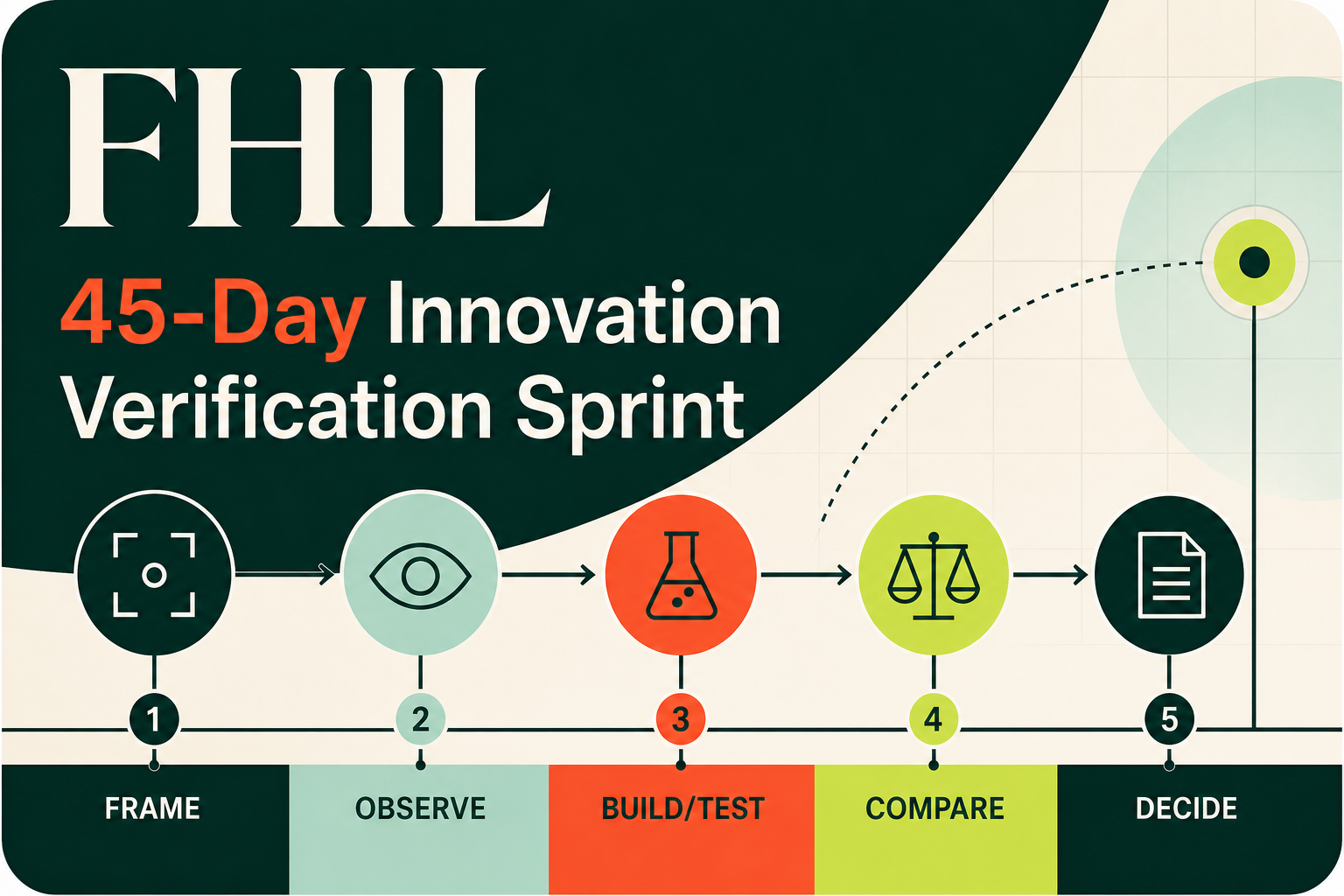
The work starts with the institution’s decision and gives the ambition its first usable form.
Agree on the decision, owner, deadline, target setting, evidence threshold, access, and the assumptions most likely to change the answer.
Buyer-visible milestoneDecision frame and evidence plan
Identify the task and where it breaks down. Use authorized interviews, observation, mapping, document review, or existing data. Check whether the barrier is information, workflow, access, or something the proposed tool cannot resolve.
Buyer-visible milestoneSystem map and prioritized risks
Build or configure the smallest working form for one complete pathway. Use existing tools where they meet the need. Test the agreed task with at least one intended user or accountable operator, within the agreed safeguards.
Buyer-visible milestoneWorking MVP used in one bounded setting
Compare the working form with the current approach against agreed task checks. Record completion, corrections, human effort, and unresolved risks where observable. State what the comparison cannot establish.
Buyer-visible milestoneTested operating form, draft recommendation, and blueprint
Hand over the MVP, evidence, recommendation, and next-action plan. Identify who would operate it, what support it needs, and the costs and responsibilities that remain before continued use.
Buyer-visible milestoneWorking MVP, Decision Gate Report, and handover
After Day 45: The client receives the decision record and may implement independently, commission another provider, or ask FHIL to scope further support. No continuation is assumed.
Authorized access to at least one intended user or accountable operator is required before Day 1. Any additional direct workflow or user evidence is gathered only when it is material, safe, lawful, and authorized; limitations remain visible in the recommendation.
What you receive
The operating form changes with the mandate. The requirement that it be usable and inspectable does not.
A usable version of the ambition that at least one intended user or accountable operator has used, one complete pathway can carry, and the institution can inspect, share, and test. The form may be software, a service pathway, a workflow, a field tool, a protocol, or a decision interface.
Who decides, what safeguards apply, which data sources must connect, and what the analysis must reveal about supply, demand, access, capacity, and friction. Where relevant, the model may specify shortage heat maps, drive-time coverage, capacity forecasts, or scenario simulations.
An Institutional Decision Gate Report documenting the decision, evidence threshold, sources, findings, risks, limitations, open questions, and recommendation. It includes an implementation blueprint setting out the roles, workflow, safeguards, evidence needs, dependencies, checkpoints, and reassessment triggers for the next commitment.
What the recommendation can say
FHIL compares the proposed innovation with the evidence and real operating conditions the decision depends on. Facts, interpretation, unknowns, and recommendations remain visible.
The available evidence supports the proposed next commitment within the reviewed scope.
The commitment is supportable only if named safeguards, limits, or dependencies are satisfied.
A material part of the model does not fit the target setting and should change before further commitment.
A defined additional test could resolve uncertainty that still prevents a responsible commitment.
The available evidence does not support continued commitment to the reviewed model or conditions.
Buyer readiness
Before Day 1, FHIL and the sponsor confirm six conditions.
The decision owner reserves one 60–90 minute weekly review, names an operational contact, and helps resolve material access or permission questions promptly. The Sprint is hybrid by default and may combine remote analysis, interviews, working sessions, on-site observation, and bounded testing.
Pricing is confirmed after the readiness review. Travel, external specialists, and third-party expenses are identified separately.
Clear boundaries
The Sprint includes a narrow working MVP, not full-scale deployment, rollout, integration, or ongoing operations. It does not certify the innovation, guarantee outcomes, replace licensed or institutional authorities, or raise capital.
The working MVP and the agreed evidence, maps, workflows, recommendations, and blueprint. The client retains ownership of its data.
Its pre-existing methods, templates, tools, software components, and know-how, subject to the engagement agreement.
Clinical, legal, regulatory, ethics, security, procurement, data, funding, and institutional approval responsibilities.
FHIL does not identify the client or publish engagement material without written permission.
After capital is committed
The 45-Day Sprint verifies one innovation before a larger commitment. The Portfolio Verification Review compares funded promises with documented delivery and portfolio learning before the next allocation.
See the Portfolio Verification ReviewBegin a conversation
Tell us what the institution is considering, what must keep working, where the innovation must work, and when the decision is due.
Do not include patient-identifiable, protected, classified, privileged, or institution-confidential information in the initial message.
Discuss a Verification Sprint Or write directly to victorladele@fhilabs.com.