Within two business days
The clock begins after the decision question, sponsor briefing, and agreed materials are confirmed.
The 48-Hour Decision Brief
A concise briefing for a principal who needs to understand an issue quickly before the next funding, governance, or leadership review.
FHIL brings together the main points, the arguments for and against, the research base, and the facts that matter to the decision. You receive a recommended position you can examine, challenge, and use.
The Brief does not change current operations. It focuses on the questions that could change the decision. It is not a full technical, legal, clinical, or regulatory review.
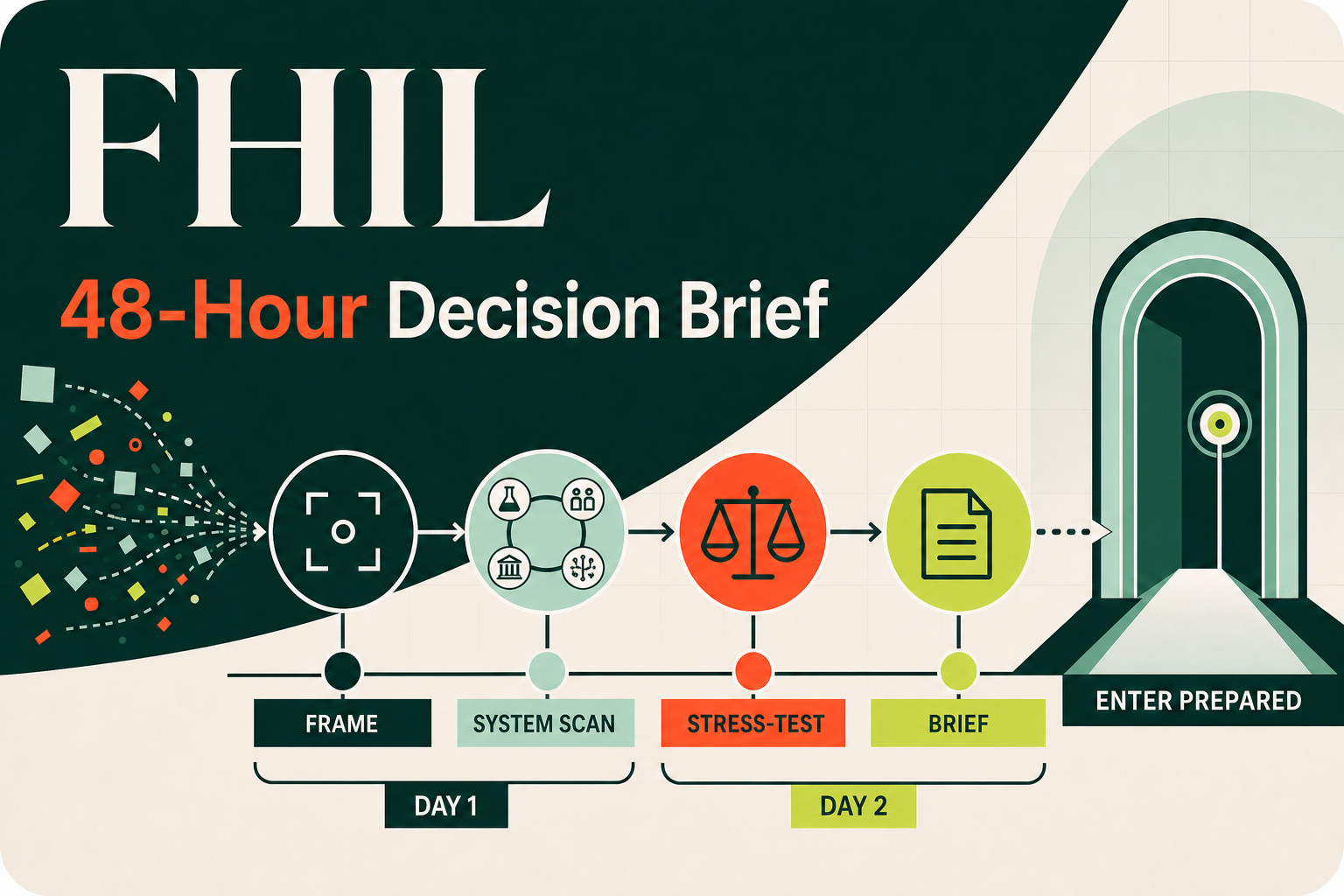
Engagement facts
The clock begins after the decision question, sponsor briefing, and agreed materials are confirmed.
A bounded investigation of the questions most likely to change the decision.
Clinical, human, institutional, technology, and future-facing questions examined together.
The main points, arguments for and against, research base, decision facts, recommendation, and sources.
Strong fit
You get command of the decision, not a pile of reading.
The system scan
FHIL examines the decision through four connected views and across precedent, present conditions, and emerging change.
Evidence quality, safety questions, care implications, and what the science does—or does not—support.
What patients, users, practitioners, and communities may encounter. When access is available, FHIL may add a small number of direct perspectives.
Workflow, incentives, governance, capacity, political exposure, population implications, and accountability.
Current capability, design choices, emerging signals, likely trajectory, and assumptions that may age badly.
How it works
The investigation is rapid because the question and source boundaries are fixed before the clock begins.
Confirm the decision, accountable owner, date, source boundaries, and the questions that could change the answer.
Investigate the evidence and the clinical, human, institutional, technology, and future-facing dimensions that matter.
Build the strongest case on both sides, expose missing evidence, test assumptions, and identify the questions the decision owner must confront.
Deliver the Brief, recommended position, decision arguments, counterarguments, questions, and source register.
What you receive
It gives the principal the issue, the cases on both sides, the research behind them, and the facts that matter.
The conclusion first, why it matters, and the position FHIL recommends within the agreed scope.
The strongest case on both sides, likely counterarguments, and the questions the decision owner should ask.
The sources examined, what each source supports, and where judgment or inference begins.
Verified facts, material unknowns, conflicting evidence, assumptions, and information limits.
Before the clock begins
The sponsor confirms the question, supplies a short briefing and agreed materials, and identifies any public or non-confidential sources that must be examined.
FHIL may add one or two user or practitioner conversations when they are relevant, authorized, and accessible within the window. If direct access is unavailable, the Brief states that limitation rather than implying firsthand evidence.
Clear boundary
The Brief does not certify an innovation, replace licensed or institutional authorities, guarantee an outcome, or verify operating conditions that were not examined. Facts, interpretation, inference, unknowns, and FHIL’s recommendation remain distinguishable.
Begin the Brief
Tell us the decision, the date, the accountable owner, what is already known, and which claims or questions require investigation.
Do not include patient-identifiable, protected, classified, privileged, or institution-confidential information in the initial message.
Request a 48-Hour Brief Or write directly to victorladele@fhilabs.com.